Flat Tire Change at the Roadside
A flat is the one breakdown people think they can handle until they are actually kneeling on wet asphalt in the dark looking for a jacking point. We carry a proper trolley jack, an impact gun and a torque wrench, and we can have the spare on and the wheel nuts to spec in about twenty minutes.
$80 to fit your spare, agreed on the phone before anyone sets off.
Stop somewhere safe first
Before anything else: get the car off the running lane. A rim is a few hundred dollars. Standing between moving traffic and a jacked up car is a different category of problem entirely. Keep driving slowly on the flat if you have to, even if it destroys the tire, until you reach a side street, a parking lot or a wide shoulder. On Highway 1 through Burnaby, aim for the next exit rather than the shoulder if you can reach it, because the shoulders there are narrow and fast.
Once stopped, hazards on, wheels turned away from traffic, and get yourself out of the car and behind the barrier if there is one. Then call. We would far rather drive an extra five minutes to a safe spot than work on a vehicle sitting in a live lane.
What we do on site
First we look at whether the tire can be saved. A nail or a screw in the tread, away from the shoulder, is a repairable puncture and often the quickest fix is a plug on the spot so you keep your proper wheel. Damage to the sidewall is different. The sidewall flexes constantly and no plug or patch holds there, so a sidewall cut, a bubble or a tear means the tire is finished no matter how small it looks. We will not plug one and tell you it is fine.
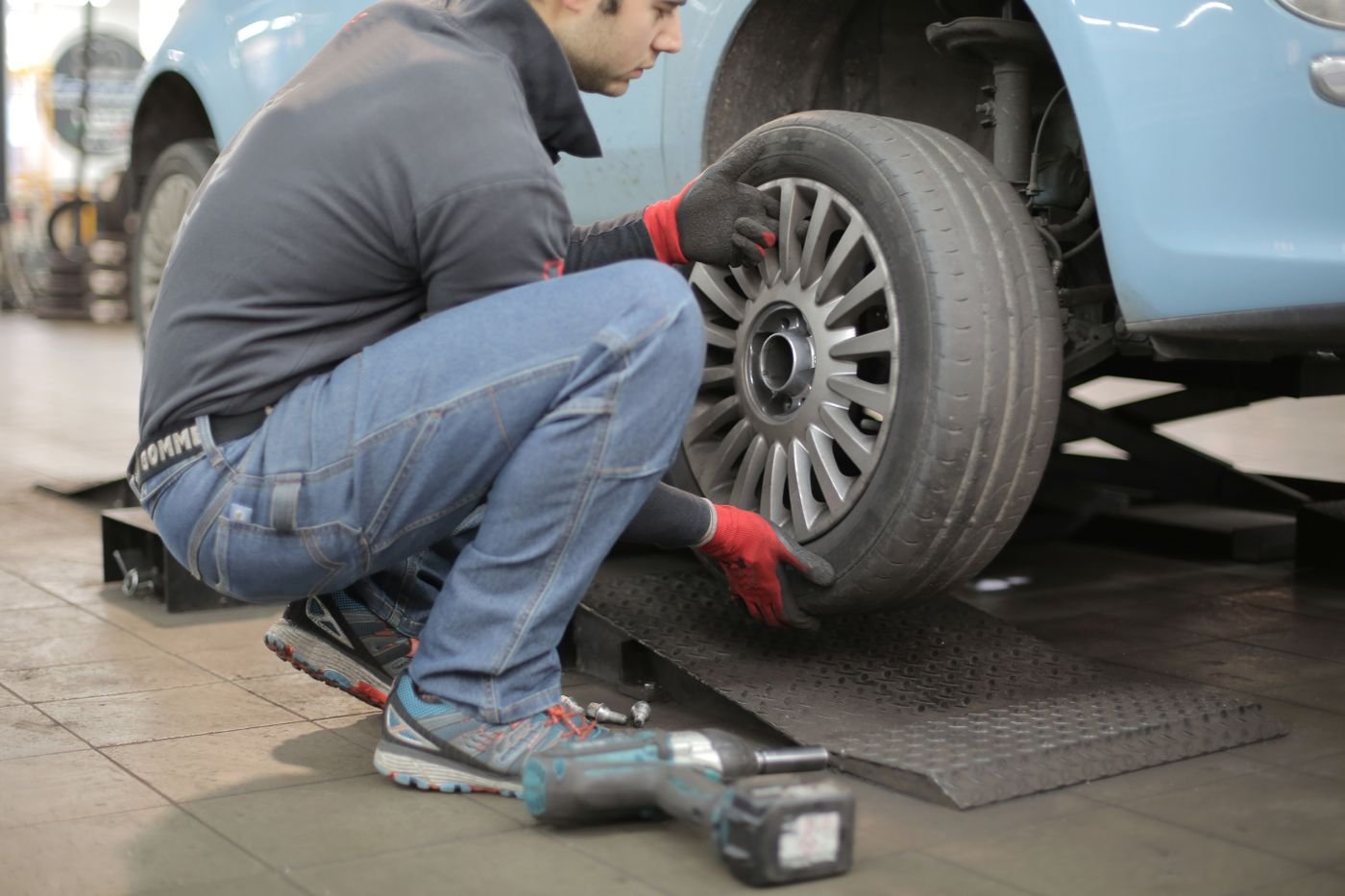
If the tire has to come off, the spare goes on. We lift from the manufacturer’s jacking point rather than whatever looks solid, which matters on unibody cars where the wrong spot bends a sill. Wheel nuts go back on in a star pattern, hand tight first, then torqued with a wrench to the figure in your door jamb or owner’s manual. Rattle gunning them tight and walking away is how studs get stretched and how wheels come loose a week later.
Retorque after 100 kilometres
This gets ignored and it matters. After any wheel comes off, the clamping load settles as the wheel seats against the hub. Any tire shop will retorque for free, and it takes two minutes. If you have an inexpensive torque wrench at home, do it yourself. Just do not skip it.
About that spare
A few things are worth knowing before you need it.
It is probably flat too. Space saver spares sit untouched for years and bleed pressure the whole time. They need around 60 psi, far more than a normal tire, and most of the ones we pull out are well under that. We carry a compressor and will inflate it before fitting.
It has a speed limit. A temporary spare is rated to 80 km/h and is meant for a short distance, not a week of commuting. Driving a donut at highway speed over the Port Mann is dangerous, and running one on a driven axle for long periods can damage a differential.
You may not have one at all. A lot of cars built in the last decade ship with a sealant kit and a small compressor instead of a spare, and plenty of newer models have neither. If that is you, say so on the phone. We will bring a plug kit and try to repair the tire in place, and if the damage is too bad for that the answer becomes a tow to a tire shop rather than a wheel swap.
The TPMS light
Canada never mandated tire pressure monitoring the way the United States did, but almost everything on the road here has it anyway, because the cars are built for both markets. If yours reads sensors inside the wheels, fitting a spare lights the warning up, since the system can no longer see a sensor on that corner, and on some cars it stays lit until the proper wheel goes back on and the system relearns. Cars that work pressure out from wheel speed instead usually just want a reset. Either way the light is not a sign we did something wrong.
The light is also worth paying attention to in autumn. Air contracts as it cools, and a tire that was correct in August can be several psi low by the first cold snap, which is why so many pressure warnings appear in the same week every year.
Where flats happen around here
Construction zones are the main source. The stretches of Lougheed Highway and Marine Way that are perpetually being worked on throw screws and offcuts, and Still Creek and the industrial blocks off Boundary Road are reliably bad for debris. Potholes after a wet winter do the other kind of damage, where the tire does not puncture but the sidewall bulges from a hard impact against a sharp edge. If you hit something hard and the car pulls afterwards, get the wheel looked at even if it is holding air.
If the tire is already shredded, tell us on the call. A tire that has been driven flat for a kilometre is not repairable and sometimes the rim is damaged too. Knowing that in advance means we arrive ready to either fit your spare or arrange a tow, rather than finding out in your driveway.
What drivers ask us
Can you repair the tire instead of fitting the spare?
Often, yes. A puncture in the tread from a nail or a screw takes a plug and holds well. Sidewall damage cannot be repaired safely by anyone, and a tire that has been run flat has usually destroyed its inner liner even if the hole looks tiny.
I have no spare and no sealant kit. What then?
A plug is the first thing to try, and it seals most punctures well enough to reach a tire shop. If the damage is past that, you need the car transported, which is worth establishing on the phone rather than discovering in a parking lot.
Do you carry new tires?
No. We fit your spare or repair the tire you have. Replacement is a tire shop job because the tire has to be matched to the others on the axle and balanced on a machine.
Can you change a tire in an underground parkade?
Yes, and it is a lot more pleasant than doing it in the rain. Give us the level and the stall when you call.
My wheel nuts are locking nuts and I cannot find the key.
Say so on the call. Without the key the wheel does not come off without specialist extraction tools, which is a shop job. Most cars keep the key in the glovebox, in the spare wheel well, or in the centre console, so it is worth a look before you give up.
How long does it take?
Around twenty minutes for a straightforward spare fit once we are on site. A plug repair runs a little longer because the tire has to be reinflated and checked for leaks.
Flat right now?
Get the car somewhere safe, then call. We will tell you whether it is a plug, a spare or a tow before we set off.