Jump Start & Battery Boost in Metro Vancouver
You turn the key and get a rapid click, or dash lights that flicker and die. That is almost always the battery, and it is the single most common call we take between November and February. We come to the car, get it running, and then spend five more minutes working out whether the battery is the actual problem or just the thing that gave up first.
$70 for a standard boost in our core area, quoted in full before we leave.
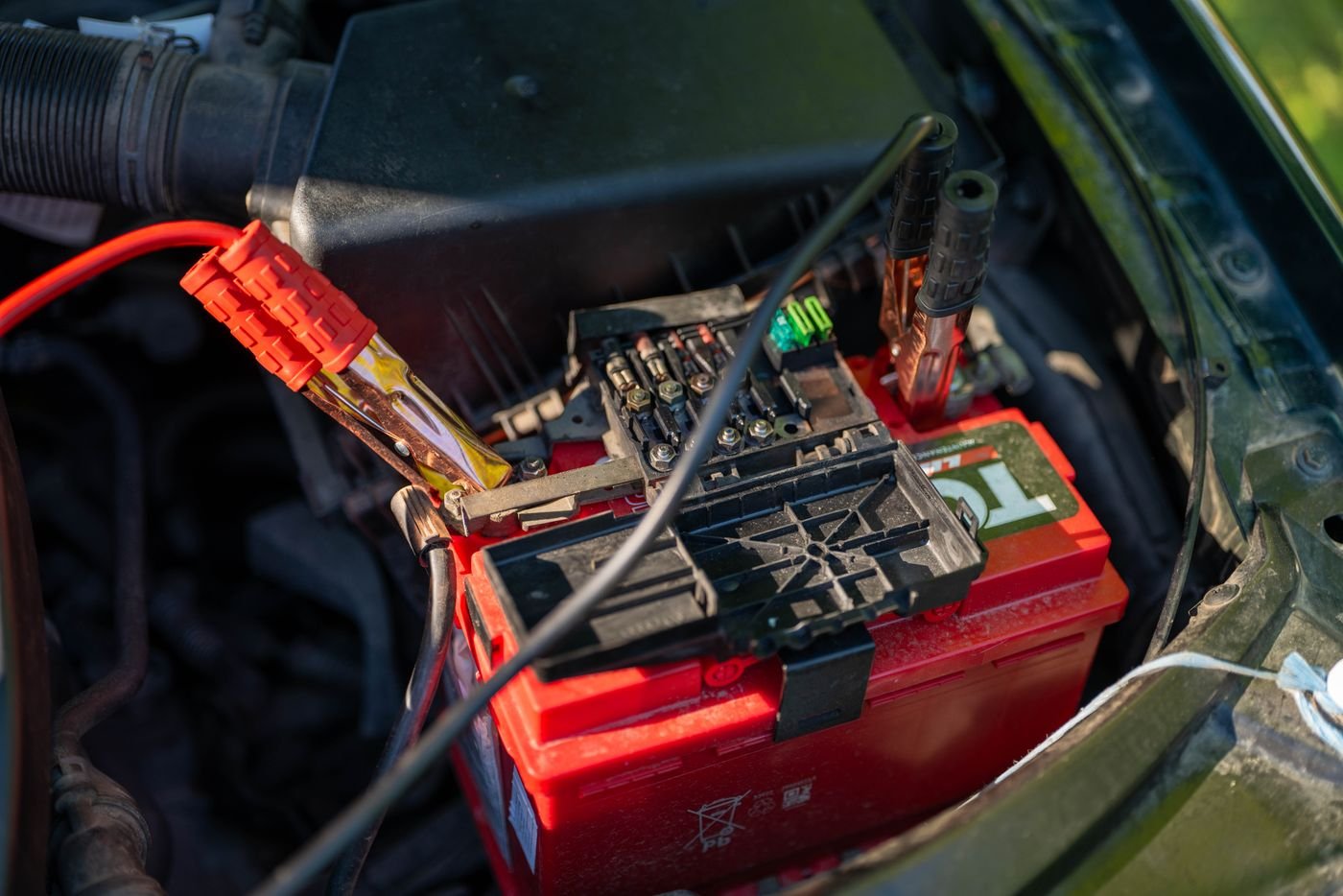
What happens when we arrive
We use a lithium boost pack rather than running cables off another vehicle. It is faster, it keeps a second car out of the traffic lane, and it does not risk a voltage spike travelling between two electrical systems. The pack clamps to the battery terminals or to the designated jump points under the hood, which matters on newer vehicles where the battery lives in the trunk or under a seat.
Once the engine catches, the work is not finished. We read the charging voltage at idle. A healthy alternator puts out somewhere around 13.8 to 14.4 volts. If the number sits down at 12.4 while the engine is running, the alternator is not charging and you are driving on borrowed time, so we tell you that before you leave rather than after you have been stranded a second time.
Why batteries die here specifically
Vancouver does not get Prairie winters, so people assume batteries last forever on the coast. They do not. A lead acid battery in this climate typically gives four to five years, and the failure almost never happens gradually. What kills it is the first properly cold week, when the chemistry slows down at the same moment the engine needs more current to turn over thick cold oil. A battery that was marginal in October is dead on the first frosty morning in Burnaby.
The other pattern we see constantly is short trips. If your daily drive is Hastings Street to a parkade ten minutes away, the alternator never gets long enough to replace what starting the car took out. Stack that over a winter and the battery slowly runs down even though nothing is broken. Highway runs over the Second Narrows or out along Highway 1 do more for a battery than any trickle of city driving.
Signs you are close to needing one
- The starter sounds slower than it did a month ago, especially first thing in the morning
- Headlights visibly dim while the engine cranks
- The car starts fine after a long drive but struggles after sitting two days
- You have already needed one boost this season
- The battery is date stamped more than four years ago
When a boost will not be enough
A jump gets the engine running. It does not fix the reason the battery was flat. Which of these you are looking at is something we can usually tell you before we leave:
- Something drained it. An interior light left on, a door not fully shut, a boot lid ajar. The battery is fine. Drive it for thirty minutes and carry on.
- The battery is finished. It takes the boost, runs, and then will not start again the next morning. Time for a replacement, and we will tell you the group size you need so you are not guessing at the counter.
- The charging system has failed. Voltage stays low with the engine running, or a battery warning light stays on. Do not switch the engine off. Drive straight to a shop while it is still turning.
And one case a boost cannot touch at all. If the engine turns over strongly and simply refuses to catch, the battery was never the problem. That is fuel, spark or a sensor, and it belongs in a workshop.
Hybrids, EVs and start stop vehicles
A hybrid still has an ordinary twelve volt battery, and it is usually that battery, not the big traction pack, that leaves a Prius sitting in a driveway. Those boost normally. Full electric cars also carry a twelve volt battery for the computers and the contactors, and when it goes flat the car will not even wake up to let you charge it. We can boost that twelve volt side so the vehicle powers up again.
Vehicles with automatic engine stop start run AGM or EFB batteries, which cope with repeated discharge better than an ordinary flooded battery. That is most of the reason they are fitted. The catch is the way back up: an AGM taken right down wants a charger with an AGM profile to recover properly, and a short drive around the block will not do it. These cars also expect a new battery to be registered to the charging system when one is fitted, so a swap at the parts counter is not always the end of the job.
Where we take these calls
Residential parkades are the big one. Most boost calls in Burnaby come from underground stalls around Metrotown, Brentwood and Lougheed, where a car sits unused for a week and then will not wake up. We are set up to work in low clearance parkades, so tell us the level and the stall number and we will find you. Street level calls along Hastings, Kingsway, Canada Way and the lots around BCIT are the next most common.
Before you call, try this. Put the headlights on. If they are bright and steady, the battery has charge and the fault is somewhere else. If they are dim, yellow or dead, it is the battery and a boost will almost certainly get you moving.
Asked on almost every boost call
Can a jump start damage my car?
Done properly, no. The two risks worth caring about are reversed polarity and the voltage spike you get pulling clamps off a running engine. A regulated boost pack with reverse polarity protection removes both, which is why we carry one instead of slinging cables between two cars in a traffic lane.
How long should I drive afterwards?
Thirty minutes of continuous driving at road speed, not ten minutes of stop and go. Highway 1 or Marine Way will do far more than circling the block. If you only have city driving available, a plug in charger overnight is better than nothing.
My battery is in the trunk. Is that a problem?
Not at all. BMW, Mercedes and several Chrysler models put the battery in the trunk or under a rear seat, and most of them also provide a remote positive terminal in the engine bay for exactly this. We know where to look.
Can you sell me a new battery on the spot?
We do not carry stock, so no. What we will do is confirm the battery is genuinely dead, read the group size and cold cranking amps off the label, and give you the numbers to buy the right one. That saves you a return trip to the parts counter.
What if it dies again the next day?
Then the battery is the problem rather than whatever drained it, and you need a replacement rather than another boost. Call us anyway if you are stuck, but we will tell you straight that a second boost is a bandage.
Car will not start right now?
Tell us the parkade level or the cross street and we will give you an arrival time on the call.